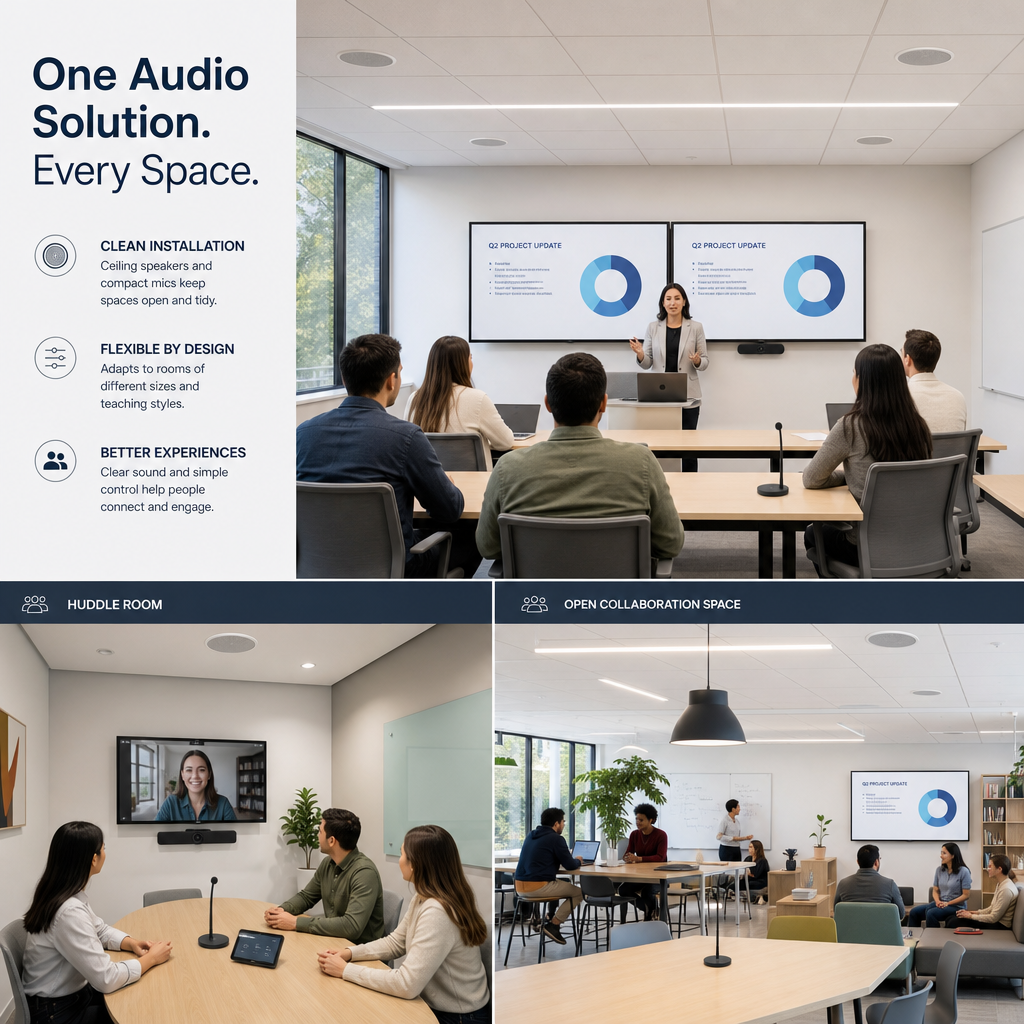
A Quiet Shift Behind the Show Floor Noise
Every InfoComm has its share of flagship launches — bigger speakers, louder specs, more processing power. InfoComm 2026 had those too. But talk to enough manufacturers and integrators on the floor, and a different pattern emerges: the loudest conversations weren't about performance ceilings. They were about installation ease and how quickly a system can be deployed, reconfigured, and supported across a building full of different room types.
This is a meaningful signal for anyone responsible for AV integration decisions. It suggests the market is maturing past the assumption that one flagship product line can serve every space equally well.
Why Flexibility Is Outranking Flagship Specs
The traditional audio sales pitch centered on peak performance — the best microphone pickup, the widest frequency range, the most impressive demo room. That pitch still exists, but it's increasingly paired with a second, more practical question: how does this actually get installed and managed across dozens or hundreds of rooms that don't look like the demo room?
Several factors are driving this shift:
- Room diversity — a single enterprise campus might include huddle rooms, large training spaces, and open-plan collaboration areas, each with different acoustic and layout demands
- Staffing constraints — facility teams are managing more square footage with fewer dedicated AV specialists, making simple setup and remote management essential
- Faster refresh cycles — as hybrid collaboration becomes permanent rather than temporary, organizations are updating audio infrastructure more frequently and need systems that don't require a full re-engineering effort each time
- BYOD-ready expectations — employees and students expect to walk into any room and connect immediately, regardless of device, which pushes vendors toward more universal, less proprietary designs
What "Easier to Install" Actually Means in Practice
It's worth being specific here, because "ease of installation" can sound like marketing shorthand. At InfoComm 2026, the practical manifestations included simplified cabling and power requirements, auto-configuration software that reduces on-site tuning time, and management dashboards that let a single administrator oversee audio settings across multiple rooms or buildings from one interface.
Several manufacturers also emphasized platform-agnostic design — audio systems built to integrate with existing video conferencing platforms, room scheduling tools, and even AI-based video analytics used for occupancy and usage tracking, rather than requiring a full proprietary ecosystem. For facility managers and procurement teams, this reduces the risk of vendor lock-in and makes phased upgrades more realistic.
What This Means for Integrators and Facility Teams
This shift changes the calculus for how organizations should evaluate audio investments. Instead of asking which product has the most impressive specs, the more useful questions are becoming operational ones: How long does deployment take across a multi-room rollout? What's required to manage and troubleshoot the system after installation? Does it play well with the collaboration platforms already in use?
For procurement specialists in particular, this is good news. It means audio decisions can be evaluated on total cost of deployment and management — not just unit price or headline features — which tends to produce more sustainable, scalable outcomes across a real estate portfolio.
A More Practical Era for Enterprise Audio
None of this means flagship innovation is disappearing. But InfoComm 2026 made clear that manufacturers are reading the room — enterprise and education buyers need systems that scale across dozens of spaces reliably, not just one impressive showcase room. That's a healthy sign of industry maturity, and it aligns with how we've long approached enterprise collaboration projects: starting with the operational reality of the space, not the spec sheet.
If you're planning an audio refresh or evaluating vendors in light of these shifts, a consultative approach that starts with your actual room inventory and workflows will get you further than chasing the newest flagship release.